Bad Days The Podcast

BCM302

Bad Days The Podcast on Spotify

Background

Bad Days the Podcast is a podcast on fashion sustainability. The essence of podcasting is the creation of audio and/or video content for an audience that wants to listen to what they want, when they want, where they want, and how they want. As the host, I explore issues that relate to sustainability within the fashion industry, as well as discuss how I can play a role in fighting this as a small business owner. Bad Days The Podcast was created as an extension of my clothing brand and also previous digital artefact Bad Days The Label. I wanted to make a podcast because I felt the need to take responsibility and advocate for change in a space that has such detrimental effects on the environment. If I want to be a part of the fashion industry, I want to do it in a way that is honest, transparent and helpful for the environment.

Project Utility

My digital artefact was created to address two problems. The first was understanding sustainability within the fashion industry and educating others on these issues. I feel that fast fashion has made us passive consumers. We see, we like, we buy. Most fast fashion pieces are cheap, poor quality, disposable, do not last very long. In Australia alone, people are dumping 15 tonnes of clothing and fabric waste every 10 minutes. Australians also buy an average of 27kg of textiles each year (including leather and homewares) and then discard 23kg into landfills, despite the fact they are mostly non-biodegradable. So the majority of it will not be resold or given to another home, just thrown away. I feel that we need to utilise social media platforms better – for awareness and education on these issues rather than advertisements.

The second was to create transparency within my own brand and to discuss how to do better as a sustainable small business. I believe that this podcast will not only help my brand with it being one of the first to be completely open and honest about their practices, it will also give my customers and followers a sense of community and support within their own sustainability journeys. Developing my project around fashion sustainability will help my users understand the fashion industry a little bit better and will help them make more conscious decisions around purchasing clothing. Additionally, it should inspire other small business owners to follow in my direction as I share my own experiences, give advice and share awareness. My audiences are self-aware, environmentally conscious individuals and business owners who want to learn more about an industry they are also passionate about.

Podcasting can also be a trickly thing to tackle. Like most other audio or video media, podcasts span the continuum from can’t get enough to deadly boring. It’s a highly subjective evaluation of course, since something you consider boring might be positively addictive for others. I was excited to take on this challenge.

I had to create succesful positioning within my brand and it’s niche by following 3 simple steps:

Understand what your consumers want

Understand what your company’s and brand capabilities are

Understand how each competitor is positioning their brand

The Branding Journal

I had a few competitors as fashion sustainability is a popular topic. However, there was a gap in the market for actual businesses who use their platform through podcasting to be as transparent as I was. Do you what materials your favourite brand uses? Do you know if they have a Code of Conduct? Do they source their final stage of production from countries with a high risk of labour abuse? These are things you should know about your favourite brands and my goal is to normalise this.

Production Method

I decided I would develop this project by posting weekly episodes discussing one topic of sustainability within the fashion industry. I wanted to take my time focusing on these issues so that the information I present was not overwhelming to the audience. I would pre-record a script (and sometimes wing-it), record my podcast, edit and post. I would then spend a few days pushing promotional content on social media platforms such as Instagram, Twitter and TikTok. As the weeks went by, changes were made to the consistent posting and amount of promotional content due to time restraints and other struggles, which you can hear about in my beta video below:

All episodes

“So you’ve got this power, you’ve got this power of sort of emotional connection, right. …it wants emotional honesty. And when you supply it it’s very effective to the audience.  And so… and it can come up in all sorts of different venues.”

Alex Blumburg | Power Your Podcast With Storytelling

Important learning moment 1: Time is everything

In my project pitch, I stated that I wanted to upload an episode every fortnight, however, because of the Covid situation affecting my ability to work, I was able to utilise my free time and upload weekly. It was going extremely well for the first 4 weeks. I felt motivated, ambitious and driven to provide quality episodes and was able to succeed in this week a fortnightly timeframe. However, as identified in my beta, I decided to normalise a fortnightly schedule as I started to feel the pressure in my time restraints. This is because Covid restrictions started to ease and I found myself easing back into my normal, pre-covid lifestyle. In order to align myself with our fast, inexpensive, simple and tiny workframe I knew that resorting back to a fortnightly schedule will be worth it. However, I was a little worried about how my audience would deal with this change and if it would be a positive or negative one.

I ultimately decided to take this risk after hearing feedback from my classmates. “Normalising a new posting schedule is important as it creates a new consistency with the audience”. According to Social Media Today, consistency is your best friend when it comes to social media. Being consistent in your post frequency is really important in order to grow a social media audience. Now if you bring that concept into the type of content you’re creating, you’re giving your audience a reason to come back every week. This new posting schedule also “allows for time and resources to create the best quality of podcasts.” It gave me more time to focus on the quality of the content. I ultimately had more time to prepare, write, practice and edit the podcast after filming.

Pictured above is some constructive student feedback from my BETA.

I posted weekly from Episode 1 (August 12th) through till Episode 4 (September 2nd). It is clear from my podcast stats that my lack of time-management from the strains of life affected my motivation and therefore ultimately affected my audiences actions. However, as I normalised the posting schedule to every fortnight my views actually spiked. Luckily, the change in schedule actually created a positive outcome for me and my podcast. It is clear that in the weeks that an episode is not released there is less downloads e.g. between Octover 18th and October 25th.

Views per week over the last 90 days via Buzzsprout
Views in the first 7 days of the last 8 episodes via Buzzsprout

To fix this issue I prioritise the promotion of the podcast through social media. This can be done via visual soundbites, q&a’s and feed/story posts.
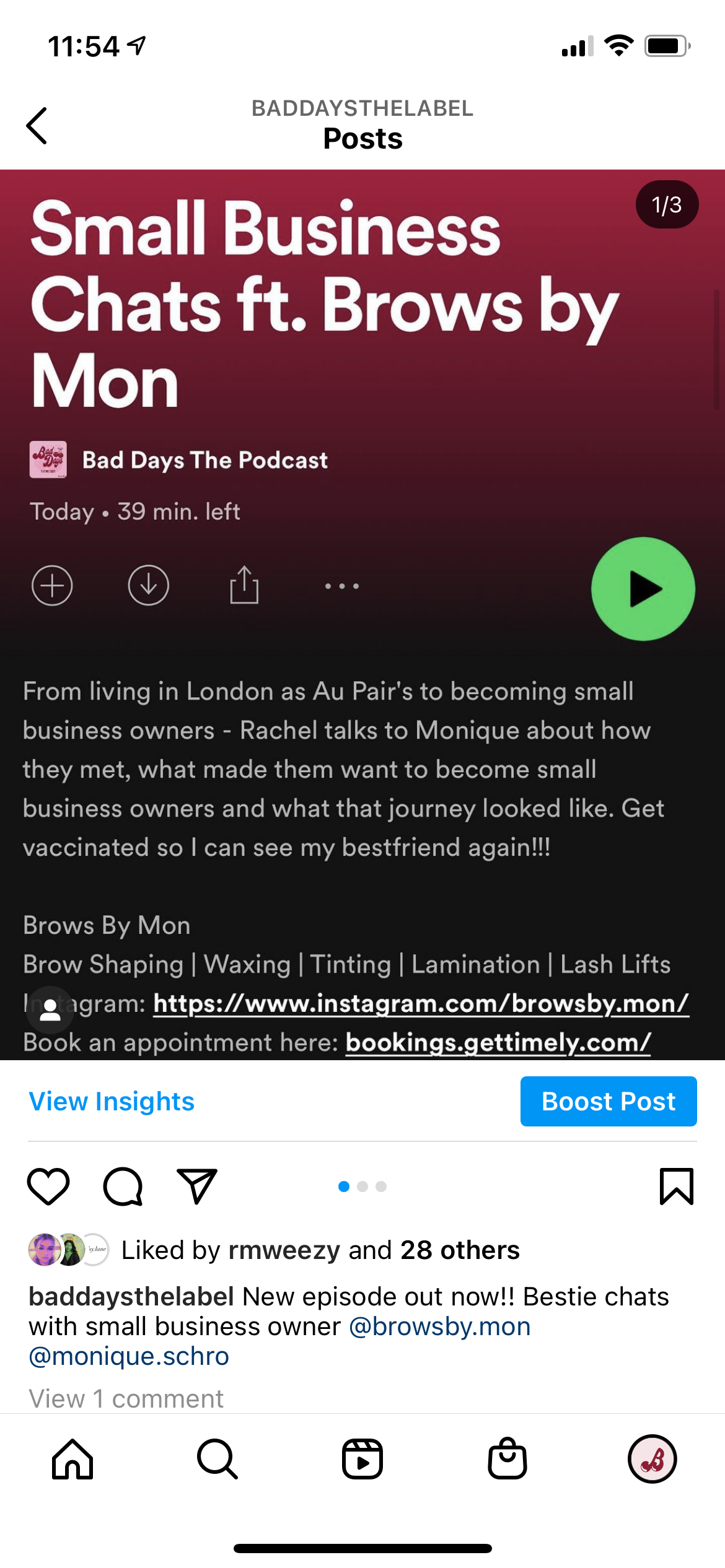
According to Linktree (the link in my Instagram bio), the podcast has been accessed 108 times from this platform

What I learnt from this is that time-management is everything. As I had other aspects of my life affect this change, I managed to be flexible and adapt. “Without this unstructuring, the creation of a new structure cannot proceed—since the bits and pieces are still tied together as meaning within unchallenge domains or concepts” (Boyd, 1976). I took a risk, and it came out successful. I could have kept with a fortnightly schedule as I prepared to in my pitch, however my passion for this project took over and I do not regret attempting a weekly schedule for it. It became an important lesson to the project.

Important learning moment 2: Camera shy

From the feedback from the BCM302 seminar in week 7 and the response from my followers, they insisted that I utilise video footage to promote my podcast. I took an extra week off uploading an episode (and normalise the fortnightly schedule) to sort out how I would be able to create video footage, whether that to be with my camera or my phone. Neither would be able to connect to my microphone which was my first issue. My second issue was that I usually record in my car in my parking garage. The reason I do this is because my voice is not bouncing off the walls like it would in my apartment. It is also more quiet as I live in an apartment complex on the first floor in a busy neighbourhood with construction that my microphone easily picks up.

Unfortunately I had to come to the conclusion that filming at this stage of my digital artefact would not align with the F.I.S.T method as it was much more time consuming and not as simple as I would have hoped. So instead, I utilised the “Visual Soundbite” mode on my podcast account to create audio snippets to promote my work on my stories, my Instagram posts and on twitter.

In my beta video I said that I felt defeated. After taking another week to think about my options, I decided that feeling defeated wasn’t one.

The first issue to combat was connecting my camera to my microphone. This is was not going to be possible, but there needed to be another way. I am a perfectionist and believe that if something is not perfect then it isn’t worth sharing to the world. I decided that this was not a good way of thinking. I had to choose between good camera quality and good sound. As the main focus of this project is the podcast itself, I decided that good sound was my priority. If I were to create video content again, I would use zoom as it is free, easily accessible and could be a new potential for including other small businesses and sustainable fashion activists into the conversation.

Feedback from Instagram
Feedback from BETA project
Testing on Zoom

My second issue was to combat the anxiety I felt surrounding being filmed. One of the issues I had with the camera in my face was my immediate shyness towards being filmed which made it hard to focus on what I was talking about. Especially as a solo creator, I knew that all eyes would be on me and I felt almost awkward about it. As I said, I’m a perfectionist.

With all of this in mind, I decided to reach out to one of my best friends and small business owner Monique, who is the owner of Brows By Mon. We spoke briefly at the beginning of this project about collaborating in an episode but I had not thought it was the right time, until now. It was like the stars aligned perfectly. My final episode (Episode 8) is my favourite episode to date. We used Zoom so I could screen record the conversation. I was able to use my microphone and she used her Air Pods. Although the sound isn’t as perfect as usual and the camera quality is average, I think that this has been my most successful episode so far. It is the fasted downloaded episode with 33 downloads in the last 36 hours (uploaded 28/10). It has been shared through both our social media platforms. I plan to have the video version up by early next week, but in the meantime have created little 1 minute video snippets that I have uploaded to Instagram, TikTok and Twitter. On top of this, I will still be able to create the audio Visual Soundbites as I did for previous episodes to have some audio sneakpeaks of the episode.

@baddaysthelabel

From living in London at 18 to being small business owners at 22 🍒Bad Days The Podcast🍒 on Spotify and Apple Podcasts #smallbusiness #smallbiz

♬ original sound – Bad Days

On top of this already successful episode, I had a friend from high school reach out to me and offer to create some music for the introduction of the episodes. It was so nice, and now I have an amazing introductory song that the audiences will soon be familiar with as I insert it into every episode.

What I learnt from this is that time, patient and trial-and-error is absolutely everything. If you work hard enough for something, you will succeed even if it is not in the way you imagined.

Important learning moment 3: Feedback is vital

Feedback was so important for my project to gain the success that it did. It pushed me to create more even when I felt defeated. Despite failing early and failing often, I had so much support around me and was so appreciative of this.

Although the majority of the feedback was positive, I always strived to take into consideration the constructive criticism as I knew that this information would help me rather than harm. For example, in episode 5 I spoke about greenwashing and other marketing tactics that fast fashion brands use to grab the attention of the younger eco-conscious generation. I recieved this private message (below) and realised that she was right. In order to avoid any defamation lawsuit (thinking worst case scenario here) I have made a note to not use words such as “allegedly,” “apparently,” and “in my opinion.” Based on the tips to avoiding defamation by Inforrn.org, I had vowed to be aware of what I am saying, control the meaning, only say what I can prove, use the language of opinion and make sure that opinion is based on true facts. This was an important learning moment for me and brought me back to BCM113.

On the 28th of September I introduced an exciting new development to the project. Originally, my podcast was only available on Spotify and the RSS feed. However, I wanted to expand and therefore uploaded my episodes to the Apple Podcast streaming service. This may not have been a necessary development as according to my Instagram poll, 83% of listeners choose Spotify. Despite this, I still believed that it was important an important choice. Switchboard, a public third-party streaming service says that streaming to multiple platforms is important because it helps you extend your reach. Using a third party service (I use Buzzsprout) makes it easy as this allows you to send one live feed and transmit it to any number of platforms you choose – simultaneously! It is also automatic once you have subscribed.

According to my statistics via Buzzsprout, Spotify reigned as the top app used to download by podcast, sitting at 101 downloads.

Despite Apple Podcasts sitting at 5th place, I still received positive feedback for my iteration, and take this as a positive development rather than a useless one. One more thing that I like about Apple Podcasts is that I can see when someone has given my podcast a rating, which is not possible through Spotify.

Some positive feedback
3 five star reviews!!

The Future of Bad Days The Podcast

I have fallen in love with this project, and am so appreciative of the positive feedback from my friends, my classmates and my followers. I am able to add this project to my portfolio for any future career opportunities in the social media and content creation field. I now have a huge amount of background knowledge that will help me in my sustainability journey as a small business owner. I have successfuly created a transparent brand and I know that I have inspired other small businesses and fashion enthusiasts to think differently and buy differently. I hope to continue this project for a long time and hope you can continue to follow me!

BAD DAYS THE PODCAST

Other references:

BCM 302 Peer Reviews Part II

BCM302

Peer Review 2: Chelsea-Lee Bastable & Emma Jenkins

Project: Chàe Media

I really loved keeping up with Chae Media on Instagram, where they post day in the life reels and tips for editorial design. Their projects utility is two-fold, benefiting the girls and their careers as well as guiding their audiences in their visual content and branding journeys. Their brand is aesthetically pleasing and they utilise this in so many methods, from Instagram stories to reels; all media that is presented to their audience is succinct and beautifully crafted. Their new iteration of utilising Instagram reels is a perfect addition to the promotion of the brand as it gives the brand a personal twist, giving their audience a chance to know who they are engaging with and connecting them to the brand. Also, Instagram’s algorithm is favouring accounts that are regularly publishing and engaging with Reels as it is still considered a new feature. 

For Chàe Media, “day in the life” reels have been a fantastic idea, utilising their mission by “continually keeping our audiences best interest in mind” and being able to “create helpful content that will produce healthy habits for our student-based audience.” I believe day in the life videos are actually vital for this. Reiterating simple but motivational day in the life content that is visually appealing will help those that have been struggling to move during this lockdown period and I admire the girls perseverance to continue creating this type of content regularly.

I do know that a mission for their brand is to advocate for passionate small businesses, and I think that they should utilise their “day in the life” videos to promote their favourite businesses. For example, pouring coffee from a local coffee company they admire or putting on an outfit that was purchased from a small business. Instagram reels not only should be used to promote your brand, but also for education, showing personality and your ethos (Social Media Today). This content will not only be located on your feed, but will be shared by the businesses you collaborate with and expanding your audience.

Secondly, I think that adding a call to action after every Instagram reel could be a positive development to the project and persuading others to like, follow, share and partake in the brands journey. Adding a call to action is important to promote your page before the release day of your editorial magazine. An article by Sister Act Media explores ways to promote your page before the launch which can be located here. Whether it be a call to invite people to view the Instagram page or the magazine itself, having both platforms will allow for easy accessibility and not only be a space for education, but also be a community for like-minded individuals who are in need of their own safe space online. I love their page and will continue following it after this semester is over!

Peer Review 2: Laura Wilson

Project: Soul Socials

Laura’s moderation of her digital artefact was a smart choice in response to the F.I.S.T method, and allowing herself to fail early encouraged the development of her new project Soul Socials. Soul Socials was created in response to the need for personal marketing tips as a one-stop source for information. Choosing Instagram was a great idea as its multiple features can be utilised to expand her audience; including stories, live videos, and ads. Social platforms help you connect with your customers, increase awareness about your brand, and boost your leads and sales (Marketing Insider Group). Her project is also twofold as she hopes to gain future full-time employment in social media management and social media marketing.

In her beta she talks about collaborating with other brands and agencies on future campaigns which is an exciting development. Upon reflection on her Instagram, there appears to be a lack of content which may affect her ability to collaborate with others who do not know who Soul Socials is yet. I believe that creating consistent content aligning with your brands aesthetics and ethos is vital towards a successful brand. Business 2 Community talks about curating your Instagram aesthetic and creating a brand identity. They touch on first impressions, trust, recognisability, differentiation and identity. Focusing on curated content and including a consistent call to action (as she mentioned she does in her beta), as well as incorporating hashtags and engaging with similar pages will get Soul Socials out into the community as a strong established brand despite being a fresh face. Secondly, spending one day a week focusing on accumulating this content will help align her project with the F.I.S.T method. This article by Canva shares how to create 50+ pieces of content weekly. Additionally, consistently adding a call to action on your posts, reels and stories will regulate customer engagement. Laura mentioned that she already utilised a call to action to market her brand on her Instagram posts. I found this article by the Social Media Examiner which will help create strong, impressionable call to actions which will drive new clients towards her page.

In another response to failing early and failing often, Laura explored other social media platforms to market herself on and considered using Facebook as a secondary platform to Instagram. According to this article by SEJ, Facebook can help reach a wider audience, create B2B and B2C campaigns, use full-funnel targeting and create audience transparency. I believe that once Soul Socials has created enough curated content, then Facebook would become the immediate next step to having a successful marketing brand and portfolio. I would suggest creating content that is set out into four methods: educational, personal, inspiring and call to action. This will help gain a passionate audience as well as create a reach to valuable new clients and collaborative opportunities. Ask yourself, what has never been done before? How can I connect with my audience? What do THEY need from me and what can I do for THEM. I’m excited to see where this project leads!

Bad Days The Podcast: Project Beta

BCM302

This digital artefact has been my favourite one to date! Not only was creating the podcast fun, but it was so simple in the beginning as it was something I was extremely passionate about and so was easy to fulfil every week. I still feel a strong passion towards it, but as I stated in the video, uploading once a week became too much as life got in the way. However, I take this on as a learning experience and believe that posting each fortnight will be a positive change for my podcast, my brand and my time.

My favourite part about this whole experience has been interacting with my followers on my Instagram stories and getting them involved, whether that be through polls, questions and feedback:

This interactive portion of my digital artefact not only helped promote my podcast, but strengthened my brand as a whole. As I said in my pitch, I wanted my brand to feel like an open space to create conversation and also create a community to talk about sustainability in an open and honest way. I believe that I have successfully achieved this! All the feedback has been positive which is something I did not expect! I always love to hear what my listeners would like me to talk about and was happy to take in any feedback and suggestions to use for my next upcoming episodes.

I had little to no expectations for the “Video Soundbite” as I am aware that video content would have really pushed my digital artefact to the next level. However, I did receive some positive feedback regarding it which is something I didn’t expect! As well as audio, I included some written sneak peaks of the episodes in some of my Instagram posts which I think gives an element of curiosity that will make the audience want to know more.

Overall I am super proud of this project. I have learnt so much and have a clear direction that I would like to take this project in the future. The end of this semester will not mean the end of Bad Days The Podcast. Over the next coming weeks I will be pushing more video soundbites and continue engaging with my audience on my social media platforms (particularly Instagram) through story media such as polls, questions and countdowns towards each episode. Pushing the social media element of my podcast will increase the number of downloads I receive. It is incredibly obvious through my analytics that more social media engagement means more listeners. As I upload more, I tend to receive more feedback. Now that I have more time between each episode, I will be able to promote them much more as I believed I would in my pitch.

As for the episodes themselves, I believe that adding Apple Podcasts as a streaming service last week was definitely a good idea. Unfortunately I cannot locate any analytics which tells me how many people are viewing on Spotify or Apply Podcasts. However, I have already received a 5-star rating via Apple Podcasts. After I upload my next podcast episode I will create a poll on my Instagram to ask which platform they listen to and reveal my findings in week 13. The next step would be trying out a video element again, which will allow me to promote my content on Youtube and TikTok. I believe this will be a huge and vital step if I want my podcast to really gain popularity, but for the time being it is just not possible. My final step would be monetisation through either sponsorships, affiliate marketing or a support link such as Patreon.

I cannot wait to continue this podcast and am so excited to see where it takes me in the future. If you want to listen check out these links below!

BCM302 Peer Reviews Part 1

BCM302

Peer Review 1: Laura Wilson

Project: Sainted Souls

Laura’s project is something that I felt extremely connected to as I have my own embroidery machine and have experienced the process of starting my own embroidery business. I feel proud being a peer reviewer for her project. In saying that, I do know a lot about the behind the scenes work and have my own experience starting an embroidery business from scratch.

As inspiring as this is, immediately I recognised that it does not align with the F.I.S.T method. This is a HUGE project and I want to share as many tips as I can so that it is as inexpensive and simple as possible. Because in all honestly, I spent around $5000 to get started. Laura has not yet purchased an embroidery machine, and these machines range from $1500 to 13,000 for a decent one. I recommend the Brother nv800e embroidery machine as it is one of the most affordable but so easy to use: Echidna Sewing Also, if she purchases it in a bundle she will be able to save money on stabiliser, embroidery hoops and embroidery thread. If this is out of budget, hand embroidery is also an option but it is not as ‘clean’ and takes a bit more time but is a much cheaper option.

I would not recommend opening a Shopify website straight away as based on my own experience. Shopify is roughly $40 a month to keep open, and on months where sales are not strong you may find yourself at a loss. Instead, I would definitely start with something as an Etsy account, which is a website perfect to promote personalised gifts. It’s super easy to promote on there and your engagement, sales and reviews on the site mean it’s easier for other buyers to find you when they are looking for personalised gifts. It also takes a small commission when you make a sale, but it is much less compared to Spotify’s monthly fee.

A lot of time is also going to have to go into finding a wholesale company that aligns with her values. I absolutely appreciate how she wants to take sustainability into consideration as that is essentially what my DA artefact is about! I will be talking about my fashion sustainability journey with my own business (and will talk about my embroidery) which you can find here; Bad Days The Podcast I also found a website that lists a number of amazing sustainable manufacturers for wholesale if which you can check out here; Sustainable wholesalers and manufacturers I would also we weary of the packaging materials to use and determine if it is in your budget to find sustainable packaging. I personally use Hero Packaging, which you can access here; Hero Packaging.

As for drawing the designs, I would recommend hiring someone from Fiverr. It will cut down production time and they will be able to convert your JPEG to a PES file (or a stitch file) rather then you doing it yourself and purchasing PES software which not only is expensive but takes so long to create. Not to share all my small business owner secrets but I trust this digitizer with my life; Fiverr Digitizer.

I think her methodology suggests a focus on social media for engagement, and in turn utilising this to create a successful brand. TikTok definitely is the place to promote a small business as I also found I got the most feedback from both TikTok and Instagram Reels. It is important to post regularly and update your followers so having the embroidery machine really helps with creating interesting content that explores your design to finish process. In all honestly, if you were to cut down your DA to align with the F.I.S.T method, I would focus all your energy into small business promotion rather than the business as a whole. Either way it will be a fascinating topic!

I love the research Laura has put into this niche trend of personalised gifts and I can tell she is  extremely passionate about this. I can tell with her research she already understands that her methodology has a lot of components to it. Her pitch was well articulated, passionate and easy to read/understand. I hope that my advice helps minimise the costs and allows Laura to align herself with the F.I.S.T methods better! I’m so excited to see where she takes this.

Peer Review 2: Chelsea-Lee Bastable & Emma Jenkins

Project: Chàe Media

I wish I had Chàe media when I was creating my own brand design for my own business! Their pitch was aesthetically pleasing and their goals for the project were very well articulated. I specifically resonated with their point about young entrepreneurs straying from the old paradigm as I have personally found that I have taken design for my own business into my own hands, uninterested in collaborating with larger-named businesses. Without any guidance I managed to create my own brand design but would have had a quicker turnaround if I knew about Chàe Media and their work. There was clearly an identified problem that was addressed, and combined with their relevant interests, the solution is an amazing tool that students can use for directed brand and editorial design.  

The slogan “for students, by students” is the first thing I see when I pop on their social media page, and it brought me an immediate feeling of comfort and community as a digital media student. I think that the digital magazine is an amazing piece of curated content that isn’t regularly done with DA projects, so it would be interesting to see how they can engage their audience and persuade them into ready their magazine. I know I am particularly excited for it! I wish that there was a timeline to observe how they are planning to feed out their content to the public and how they will utilise their time efficiently, just so that I could understand their process a little bit better and know WHO was creating WHAT.  

I think that boosting their social media presence through video media could be a vital next step into engaging their young audience (students) through Instagram reels and Tiktok. Having followed them on Instagram for a while, I believe they already utilise their Instagram stories efficiently and the content is always so aesthetically please, kind and informative. Another one of my recommendations would be to find ways to monetise their work. Because they put so much into this as a team it would be a shame if they didn’t take this opportunity. I believe if they utilised sponsors and found brands that aligned with their values and created collaborations – I think that this might be a fun opportunity.

I also think that content that can take students minds away from the Covid situation and onto focusing on their creative works could be a valuable experience for their audience as I think for these times we need a distraction more than anything. Their projects utility is two-fold, benefiting the girls and their careers as well as guiding their audiences in their visual content and branding journeys. Can’t wait to see all the content they create and to apply their tips into my own DA and small business!

BAD DAYS THE PODCAST – Project Pitch

BCM302

My digital artefact addresses the issues regarding sustainability in the fashion industry. I am incredibly aware and am passionate about the human and environmental impacts of the fashion industry, particularly fast fashion. I believe that it is important for brands to be transparent about how their clothes are made.

I believe this podcast will not only help my brand with it being one of the first to be completely open and honest about their practices, it will also give my customers and followers a sense of community and support within their own sustainability journeys. Developing my project around fashion sustainability will help my users understand the fashion industry a little bit better and will help them make more conscious decisions around purchasing clothing.

I will be releasing a new podcast episode every fortnight. This will give me time to do my research, write a script, record and then also more time to promote my episode after its release. My podcast will be available on Spotify and Apple Music. I will promote it on my social media platforms but particularly Instagram as this is where the majority of my engagement comes from. I will ask for feedback on my stories and through reviews on these podcast platforms.

Fast: Content is readily available and accessible on multiple platforms, podcasts are fairly short (20-30 minutes in length) and creating small snippets of my audio to post on social media is an easy and fast way to promote.

Inexpensive: Microphone has already been purchased under my brand, and no additional costs are needed for this project.

Simple and Tiny: The main task is creating the podcast and editing. All promotional platforms are already set up and content just needs to be uploaded. This is also only an extension of my brand rather then creating a digital artefact on ALL aspects of the brand as I have done before.

I have already thought of the concepts that I will be talking about each episode and have created a timeline to add structure to my content creation:

Creating smaller steps will not overwhelm the audience as much and may influence them to change their perspectives faster. They will then be able to immediately apply these changes in their own home.

I think that this is going to be an incredible experience because I have always found it so nice when brands are engaging with their audience about things they care about. It is always important to shop small and sustainable and I cannot wait to talk more about it.

Here is the link to the podcast, first episode is already live!! CLICK HERE

Initial Research and References:

Ecocult. 2021. Greenwashing Alert: What is Bamboo Fabric, and is it Sustainable?. [ONLINE] Available at: https://ecocult.com/bamboo-fabric-sustainable-eco-friendly-greenwashing/. [Accessed 7 August 2021].

Good On You. 2021. How We Rate. [ONLINE] Available at: https://goodonyou.eco/how-we-rate/. [Accessed 7 August 2021].

Independent. 2021. How expensive should fashion really be?. [ONLINE] Available at: https://www.independent.co.uk/climate-change/sustainable-living/fashion-sustainable-expensive-how-much-b1855956.html. [Accessed 7 August 2021].

Kristen Leo. (2021). Fast Fashion Explained In Under 5 Minutes. [Online Video]. 27 September 2018. Available from: https://www.youtube.com/watch?v=fR7bXsoNwwE. [Accessed: 8 August 2021].

Observer. 2017. In Defense of Fashion as a True Art Form. [ONLINE] Available at: https://observer.com/2017/06/fashion-true-art-form/. [Accessed 6 August 2021].

Shelbizleee. (2021). ranking sustainable brands from BEST to WORST (everlane, seventh generation, organic basics & MORE). [Online Video]. 20 January 2020. Available from: http://www.youtube.com/watch?v=X68WTP-6r7c. [Accessed: 8 August 2021].

TedX Talks. (2019). I Broke Up With Fast Fashion and You Should Too | Gabriella Smith | TEDxWynwoodWomen. [Online Video]. 11 April 2019. Available from: https://www.youtube.com/watch?v=mKPB0uW4cto. [Accessed: 8 August 2021].

The Stitchess. (2021). The ACTUAL Risks of Thrifting Clothes. [Online Video]. 22 November 2020. Available from: https://www.youtube.com/watch?v=I8oS8jDMooQ. [Accessed: 8 August 2021].